The Basics
What Austin honky-tonk two-step actually is
Two-step is a partner dance done to country music - specifically to songs in a 4/4 time signature at a medium-to-fast tempo. You and a partner move together around the dance floor counterclockwise (called the line of dance). The leader navigates the floor while the follower responds to their lead.
The "two-step" name comes from the rhythm pattern, not literally two steps. The pattern is slow-slow-quick-quick - two slow steps followed by two quick steps, repeating continuously. That's the foundation of everything.
The Austin honky-tonk style is danced closer than many other two-step styles, with a strong emphasis on connection between partners and responsiveness to the music. It's not a show dance - it's a social dance. The goal is to move well together, not to perform.
The Austin Difference
A regional dialect: Austin honky-tonk two-step vs. everything else
Two-step is not one dance. It's a family of dances - related by rhythm and structure, shaped into completely different forms by the floors, the music, and the communities where each style grew up. Before you walk into an Austin dance hall, it helps to know where your version fits.
There's nightclub two-step, a slow, romantic style suited to R&B and pop. There's Arizona two-step, compact and slot-based, danced to faster tempos. There's Cajun two-step, which borrows heavily from zydeco and Cajun waltz. There's classic country two-step - the big, sweeping progressive style popularized by Urban Cowboy and still taught in ballrooms and competitions - that travels in wide loops around the floor with an upright, extended frame, precise shapes, and deliberate technique. That last one is a beautiful dance. It's just not the dance Austin dances.
Austin honky-tonk two-step is a regional dialect - a version that evolved over decades on dance floors that were simply too small for a progressive dance once the crowd showed up. The White Horse. Donn's Depot. Sam's Town Point. The Continental Club. These aren't ballrooms. On a full Saturday night, there's no room to travel a wide loop counterclockwise. So dancers adapted: the frame got closer, the footprint got smaller, swing elements blended in to make the dance playful and musical in a compact space.
The result starts on the slow - slow-slow-quick-quick - which lands the emphasis differently than the quick-first ballroom style. It's not formulaic or shape-obsessed. It's improvisational, responsive to the band, and built for real floors with real crowds. That's the dance this guide teaches.
Both styles are legitimate dances with their own context and history. We just happen to live in Austin.
The Pattern
The footwork: slow first, 3 counts
Despite having four steps, two-step is counted in threes: each slow step gets one beat, and the two quick steps share one beat. The phrase is: slow (1) - slow (2) - quick-quick (3). Then repeat. The grid below shows the four steps mapped across those three counts:
Four steps, three counts. The two quicks split one beat between them.
Leaders (left hand reaches out, right hand on partner's back): step forward with the left foot on count 1 (slow), bring the right foot together on count 2 (slow), step forward with the left foot on count 3 (quick), bring the right foot together on count 4 (quick). Then repeat.
Followers (right hand in leader's left, left hand on leader's shoulder): step back with the right foot on count 1 (slow), bring the left foot together on count 2 (slow), step back with the right foot on count 3 (quick), bring the left foot together on count 4 (quick).
The pattern above is the basic traveling pattern. As you get more comfortable, you'll learn turns, underarm passes, and other variations. But honest truth: you can have a great night at Broken Spoke knowing only the pattern above. The music does most of the work.
Lead and Follow
How partners communicate
Two-step is a lead-follow dance, which means one partner makes decisions about direction and timing and the other responds. In Austin honky-tonk style, this communication happens through physical connection - the frame, the tension in the arms, the weight shifts - not through pushing or pulling or verbal cues.
The leader's right hand sits on the follower's left shoulder blade. The follower's left hand rests on the leader's upper arm. This creates a shared structure - a "frame" - through which information passes.
Good leading comes from your torso and weight shifts, not from pushing your partner's arms around. If you want to turn right, your body turns right and your partner feels it and responds. If you're grabbing or steering with your hands, you're working too hard.
Good following means staying connected and responsive rather than anticipating what comes next. Don't lead yourself - wait for the information to come through the frame and respond to it. This is harder than it sounds and more rewarding when it clicks.
Two-step feels best when both partners have the same "weight" in the connection - not limp, not rigid. Think of it like a good handshake: present and engaged without squeezing. That matched tension is what makes the dance feel connected.
The Floor
Austin floors don't move like a lazy river
Most two-step styles assume a dance floor that flows continuously counterclockwise - a lazy river where couples travel the perimeter together at roughly the same speed, faster dancers in the outer lane, beginners closer to the center. That's the ideal. It's how the dance is designed to work, and on the right floor with the right crowd, it's beautiful.
Austin floors are usually not that floor.
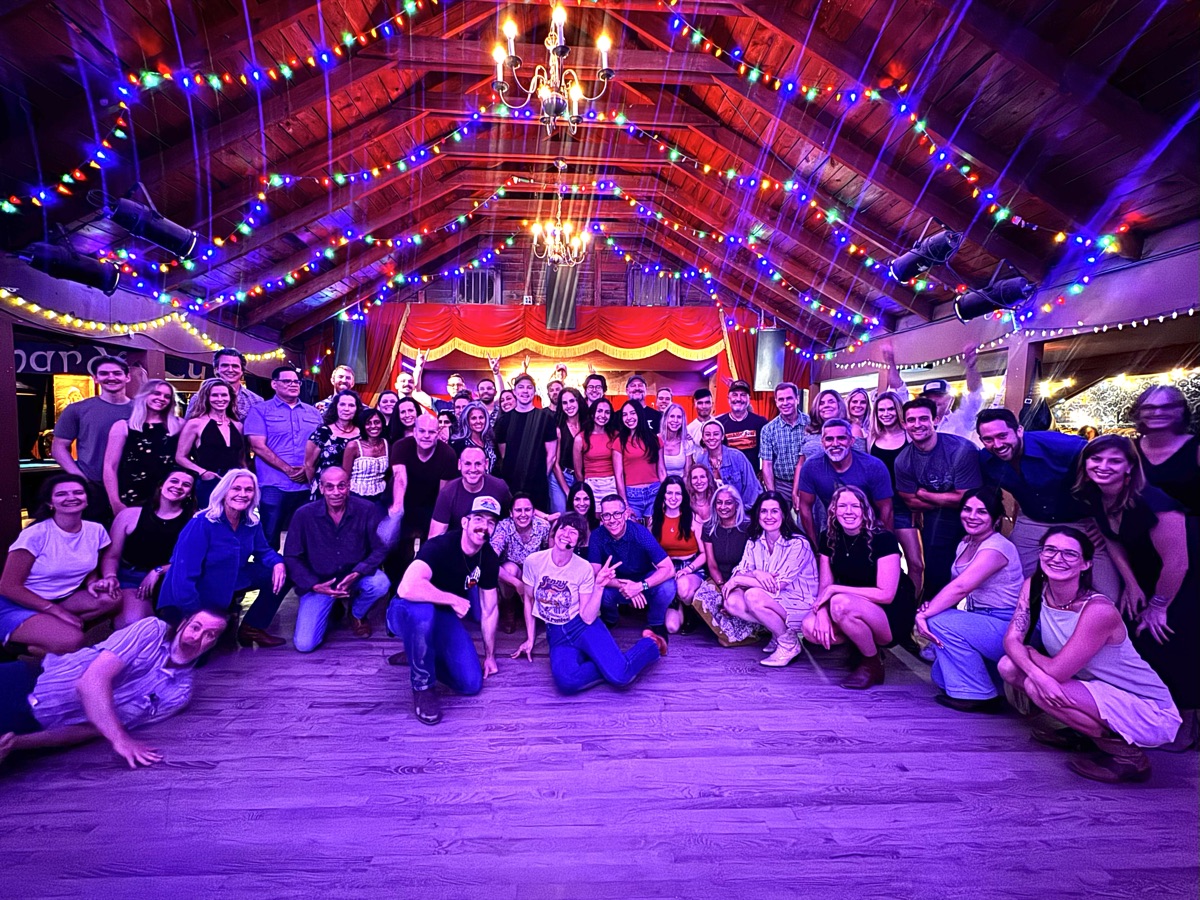
The venues here - White Horse, Donn's Depot, Sam's Town Point, the Continental Club - are small and they fill up. On a typical weekend night, and honestly on a lot of weeknights, the floor is packed well before the band hits its stride. Counterclockwise travel exists in theory but stalls in practice. There's no room to move forward. The lazy river turns into bumper cars.
This is not a problem. It's the whole reason Austin honky-tonk two-step evolved the way it did. Decades of dancing a progressive dance on floors too small for travel pushed the style toward something more compact - closer frame, smaller footprint, and a heavy incorporation of swing. Swing elements (turns, underarm passes, pivots, rotational patterns) let you stay musical and connected without going anywhere. You don't need a lane. You need a small circle of space and a partner to dance with, and you can have a genuinely great time all night.
The counterclockwise convention still matters and is worth knowing - don't go clockwise, don't stop in traffic, stay aware of who's around you. But if you show up from a scene where the floor moves like a well-organized lazy river and you're frustrated that Austin's floors don't behave that way, you're bringing the wrong expectations. The dancers here aren't doing it wrong. They're doing a different dance.
What to Wear
Boots, jeans, and everything else
There is no dress code at Austin honky tonks. You can wear whatever you want and nobody will say anything. That said, what you wear affects how you dance, and leaning into the aesthetic is its own kind of fun.
Footwear matters most. Leather-soled shoes or boots slide across wooden dance hall floors in a way that rubber soles don't. If you're wearing sneakers or rubber-soled shoes, your feet will stick slightly and the dance will feel harder than it should. This is the single biggest equipment upgrade you can make. Cowboy boots with leather soles are ideal - they're also just correct for the setting.
If you're not ready to invest in boots yet, leather-soled dress shoes work fine. Some dancers use suede-soled dance shoes. Avoid sneakers, flip flops, and chunky-soled boots that grip the floor.
Jeans and a western shirt are always appropriate. Wear what makes you feel good - but know that dressing the part at Broken Spoke or Luckenbach isn't cosplay, it's respect for the tradition.
Common Mistakes
What most beginners get wrong
Where to Practice
Best Austin venues for new dancers
The fastest way to improve is to take one lesson and then go dancing immediately after, while what you learned is fresh. These are the best Austin venues for beginners:
Finding the Right Teacher
What to expect from beginner to advanced
Before anything else: find a teacher who actually dances the way you want to dance. Watch them on the floor before you ever take a class. Study how they move, how they connect with partners, how they respond to the music. Do not assume that anyone with cowboy boots and a microphone is teaching the style you actually want to learn. A lot of people teach two-step. Not all of them social dance. This is a social dance, and it is learned through time in the room, not through a curriculum.
If you want to dance the Austin honky-tonk style, learn from someone who dances it every single week and teaches from hard-earned experience. Then trust your own eyes on the floor.
Most people have a working understanding of the basic pattern within an hour. That said, most Double or Nothing students retake the beginner lesson five to ten times - not because they didn't get it, but because that's how you build muscle memory. The repetition turns something you're thinking about into something your body just does. You also make new friends, gain confidence on the floor, and start to feel the music instead of counting through it.
From there, the intermediate class breaks down all the essential positions - closed, open, side-by-side, inside turn, outside turn - and how they connect to each other. Each week covers a different piece of the dance so the vocabulary builds gradually rather than all at once.
Advanced class puts it all in the blender. A brand new pattern every single week - and we haven't repeated one since the class began in 2023. At that level it's less about learning steps and more about developing your own voice in the dance.
Class vs. Bar
Why the two-step in class looks different from the two-step at the bar
This trips up almost every new dancer, and it is not your fault or your instructor's. There are two different things both called "two-step," and they are built for two different rooms.
Studio or competitive two-step is what a lot of ballroom and country-western studios teach. It travels in long straight lines, with sharp promenades and big patterns like grapevines that carry you from one end of the floor to the other. It looks sharp and it scores well in competition, where you have a big empty floor to cover.
Honky-tonk two-step is what you actually see at the bar. On a crowded floor at the White Horse or the Broken Spoke, nobody has room to grapevine across the room. Dancers move in a gentle counter-clockwise oval around the outside, and a lot of couples stay close to one spot, doing turns and spins in place. It is smoother, tighter, and built for a packed floor and a real connection with your partner over covering ground.
Neither one is wrong. They are the same dance adapted to different rooms. But if your goal is to walk into an Austin honky-tonk and feel at home, you want the social, bar-floor version, not the competition patterns. If your class keeps drilling long traveling sequences and you only ever want to dance at the bar, it is fair to tell your instructor exactly that: "I want to feel confident social dancing on a crowded honky-tonk floor." A good instructor will adjust. If they cannot, it is okay to find one who teaches the social style.
One more thing worth knowing: the step itself changes a little by region. Texas two-step is not quite the same as the two-step you will see in Nashville or New Orleans, and you will even hear Texans argue about quick-quick-slow versus quick-quick-slow-slow. They are close cousins. Learn one and the rest come easy.
Etiquette
Dance floor etiquette
A little common sense goes a long way in a honky-tonk. None of this is complicated, and nobody expects a first-timer to know all of it. But knowing the basics will make your first night smoother and get you more dances.
Keep drinks off the dance floor. Always. Two-step is a moving dance, more active than standing around at a club, and a spilled beer on a wood floor is how someone rolls an ankle. Finish it or set it down at your table before you step on.
Ask people to dance, and do not take a "no" personally. Most people will say yes. If someone says no, "okay, thanks" and move on. No sulking. And you are allowed to say no too. "No thanks" is a complete sentence, and it does not need a reason.
Learn the line of dance. On a big floor like the Broken Spoke or Gruene Hall, couples travel counter-clockwise around the outside edge, like cars on a track. Faster dancers stay to the outside, slower ones move toward the middle. If you want to dance in place instead of traveling, the center of the floor is yours. Smaller rooms often skip the traveling altogether and everyone dances in place. Watch for a minute when you walk in and you will see which kind of room you are in.
Stand near the floor if you want to dance. Sitting at a far table or hanging by the bar in your coat reads as "not dancing" or "about to leave," and people will not ask. Post up near the edge of the floor and you will get asked a lot more.
FAQ
Common questions
How long does it take to learn to two-step?
The basic pattern can be learned in one lesson. Feeling comfortable enough to enjoy dancing at a real honky tonk usually takes one or two lessons plus an evening of actual dancing. Getting genuinely good - fluid, musical, confident in a crowded floor - takes months of regular dancing. The good news is the whole journey is fun.
Do I need a partner to learn?
No. Double or Nothing Two-Step lessons rotate partners throughout, so you dance with everyone in the class regardless of whether you brought someone. Solo dancers are welcome at every Austin venue on our schedule.
What's the difference between two-step and line dancing?
Two-step is a partner dance - you're connected to another person, leading or following, moving together around the floor. Line dancing is done solo in synchronized groups, no partner contact. Most Austin honky tonks have both happening at the same time, often on different parts of the floor.
What music do you two-step to?
Traditional country, honky-tonk, Western swing, and many Texas country songs in 4/4 time at a moderate to fast tempo. Classic two-step songs include anything by George Strait, Willie Nelson's uptempo songs, Bob Wills and the Texas Playboys, and most of what you'll hear at Broken Spoke on a weeknight. If you can hear a strong beat and the tempo makes you want to move your feet, you can probably two-step to it. Download our playlist here →
Is Austin two-step the same as Texas two-step?
Related but genuinely distinct. Traditional Texas two-step starts on the quick (quick-quick-slow-slow). Austin honky-tonk two-step starts on the slow (slow-slow-quick-quick) and blends the swing dance tradition into the two-step frame - we call it "swing in the style of two-step." The footwork pattern is the same four counts but the starting point and the resulting feel are completely different. Austin's style evolved on small local dance floors over decades and is what you'll find on the floors at Broken Spoke, White Horse, and Sagebrush - and what Double or Nothing Two-Step teaches. Read the full history, with sources →
Why does two-step in class look different from two-step at the bar?
Studio and competitive two-step travel in long straight lines with big patterns built for an open competition floor. Honky-tonk two-step moves in a tight counter-clockwise oval with many couples turning in place, because bar floors are crowded. It is the same dance adapted to two different rooms. If you want to dance at honky-tonks, learn the social, bar-floor version.
Should I learn studio two-step or social two-step?
If your goal is dancing at honky-tonks and bars, learn the social, bar-floor version. Tell your instructor you want to feel confident on a crowded social floor, and find a teacher who focuses on that if yours only drills competition patterns like long grapevines and sharp promenades.
What are the rules of two-step etiquette?
Keep drinks off the dance floor, ask politely and accept a "no" gracefully, follow the counter-clockwise line of dance on bigger floors (faster dancers outside, slower toward the middle, dance in place in the center), and stand near the floor if you want to be asked to dance.
Is Austin two-step competitive?
Austin honky-tonk two-step is a social dance, not a sport. Double or Nothing Two-Step does not run competitions, rank dancers, or award trophies. The focus is on connection, music, and the people you meet on the floor - not scores or rankings.
Practice between nights out. Take the full honky-tonk two-step course online, on your own time.